
In the small village of Lubhoro A, nestled in Kenya’s Taita Taveta County, 75-year-old Juliana Metinyoki reflects on a life once filled with farming and independence. For decades she cultivated plantains and vegetables, tending her land with care. But in 2000, her vision began to blur, and the decline was relentless.
“The blurry vision turned into complete darkness. I could not go to my farm anymore, and even cooking became impossible.” She explained with quiet sadness, “The eyes cannot see fire—how can one cook without seeing the kitchen?”
Juliana’s diabetes worsened her condition. Daily life, once rich with visits to friends and community gatherings, narrowed to the confines of her home. “I used to enjoy visiting my friends, but now they do not visit me. My condition has deterred me from visiting them,” she shared.
Thankfully, her family stepped in. Her daughter-in-law, Stella, became her caregiver, making sure Juliana took her medication and attended medical appointments. Her son Kazai added: “As a family, we struggled to get treatment for my mother due to financial constraints… I chose to hold onto hope that one day, she would regain her sight.”
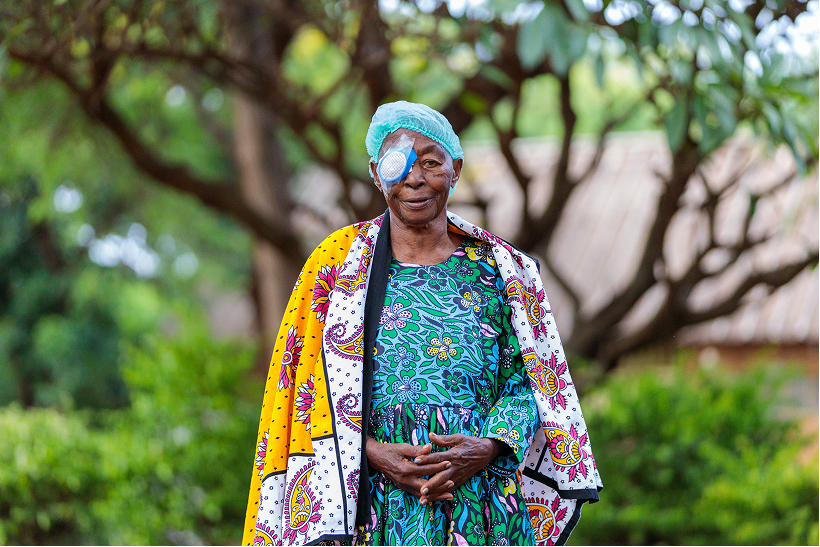
That hope became reality when community health promoter Honesty Sayeti connected them to a CBM Global partner through an outreach run by Lighthouse for Christ Eye Centre. Referred for surgery at Taveta Sub-County Hospital, Juliana faced her fears. “I was scared,” she admitted, “but I did not want to end up like my sister, who is blind and depends on others for everything.”
On January 20, 2025, Juliana underwent cataract surgery on her right eye, followed later by her left. Both operations were successful. The outcome was transformative. “I can see my farm, my family, and the world again. I thank God for using the doctors to treat me.”
Today, Juliana is back tending to her chickens and looking forward to planting maize again. She beams: “Now that my vision is restored, I look forward to resuming farming. I can also cook for my family and visit my friends. Life feels bright again.”
Gratitude fills her words when asked about CBM Global Disability Inclusion: “I thank the donors of this project for bringing eye-health services to us. If I had maize from my farm, I would give them as a token of appreciation.” She also stressed the importance of community health promoters, who connect isolated people like her with treatment.
Juliana now encourages her neighbors to seek care, leaving harmful traditions behind. “I want to tell my sister and neighbors not to rely on cultural norms that prevent them from seeking treatment. There is hope at the hospital.”
Her restored sight is more than a medical success—it is a return to dignity, work, and belonging.