

inclusive
eye health
Expanding Access
to Eye Care for All
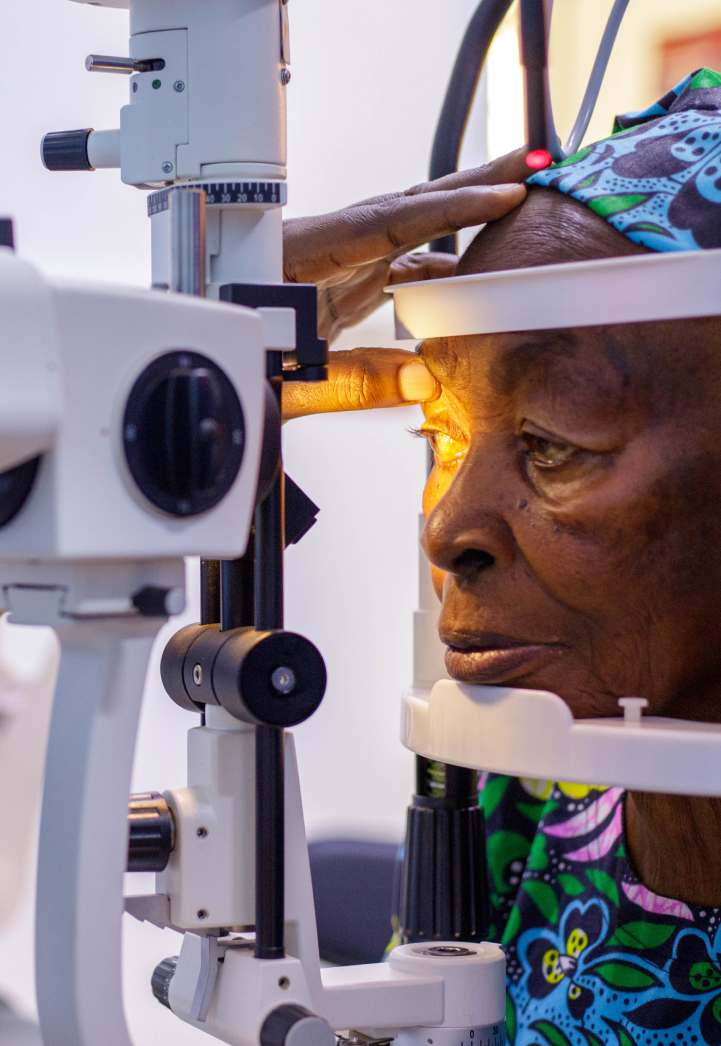
Due to a lack of access to eye health care, a billion people worldwide are blind or visually impaired. Access to simple procedures such as cataract surgery or a pair of glasses is out of reach for many women, men, and children who live in poverty.
We work to improve everyone's access to inclusive and comprehensive eye health services by strengthening national eye health systems, making services affordable and accessible to the poorest and most marginalised people, and assisting in the elimination of Neglected Tropical Diseases, even among the most vulnerable groups.
building inclusive eye health systems
We want everyone to benefit from inclusive eye health initiatives at CBM. To achieve long-term results, we make sure that our projects:
Are integrated to national health systems and policies rather than being standalone initiatives.
Are comprehensive from the promotion of healthy eyes to the prevention of eye diseases.
Are curative in medical, surgical and optical intervention.
Enable access to rehabilitation services, utilising local government and community approaches.
Strengthen support for people with permanent vision impairment so that no-one is left behind.
For more information and interest in partnership, please contact Mahbub Kabir at mahbubkabir@cbm.ie
removing barriers to inclusion
We embody inclusion at every level, from policy to patient care, to ensure no one is left behind. We do this by:
Understanding the impact of stigma.
Addressing design and accessibility barriers.
Directly consulting with people with disabilities and their respective organisations.
Lobbying for government and policy support.
Connecting through community-based programs.
Ensuring barriers for women and girls are addressed

our work to end neglected tropical diseases
Neglected Tropical Disease (NTD) programmes are supported by CBM in regions where these illnesses have been identified as a public health issue. By building on our long experience and existing strengths we aim to achieve a programme that is inclusive, comprehensive, integrated, cross-cutting, holistic, person-centred and country-led, following the WHO NTD Roadmap 2021-2030, the Sustainable Development Goals (SDGs) and CBM Irelands Vision.
Over one billion individuals are affected by or at risk of developing one or more of these chronic and disabling diseases. Each year, over half a million people die as a result of NTDs, which inflict pain, deformity, and mental and physical disability.
It is often aggravated by social stigmatisation and discrimination, especially for women. The onset of disease is usually gradual, and serious impairment commonly develops after years of silent infection, leaving patients unaware of the need for treatment.
How do we tackle
neglected tropical diseases?
1. Breaking the infectious cycle through mass drug administration
This is accomplished by the donation of curative drugs by large pharmaceutical corporations such as Merck & Co., Inc. and GSK. CBM works with communities to build sustainable initiatives that distribute these medications to all individuals who are at risk. We conduct surveys on a regular basis to ensure that we're on track to meeting our objectives and to guarantee that these diseases have been eradicated do not come back.
2. Helping those already affected by infectious diseases
If left untreated, some NTDs can result in debilitating, disfiguring physical illnesses as well as severe psychological implications for patients and their families. Through our community mental health programs, CBM is a leader in providing mental health assistance to persons living with disabilities caused by NTDs. Further, through our inclusive eye health work, we seek to prevent blindness for those with trichiasis; the end-stage of trachoma that leads to blindness.
3. Preventing these diseases through Water, Sanitation & Hygiene (WASH)
WASH is the bedrock for the prevention of numerous NTDs and a critical component in establishing long-term control or eradication. Although CBM is not directly involved in the implementation of WASH programs, we collaborate closely with partners who are to ensure that WASH programming is accessible to persons with disabilities.
4. Leaving no one behind in Trachoma and other NTD-eradication
It is becoming increasingly evident that a medical-only approach to NTD programming falls short of tackling poverty and illness as equally important causes. At the "End of the Road," CBM investigates how holistic and inclusive programming might address some of the various vulnerabilities faced by those impacted by NTDs. CBM's NTD approach addresses intersectional issues by improving morbidity management, including economic empowerment, reducing stigma, increasing access to WASH regardless of people's physical or cognitive abilities, responding to climate change, and improving mental health, as well as more effectively involving community stakeholders in all stages of NTD programming.
A Global Lens on Eyecare
On 21st April 2026, CBM Ireland convened A Global Lens on Eyecare in Dublin, bringing together clinicians, researchers, technologists, policymakers, and global health practitioners from Ireland, the United Kingdom, Africa, and beyond.
The event was explicitly designed not only to examine the scale of global eye health need, but to interrogate how known solutions can be delivered equitably and sustainably at scale.
Learn more about our work and this event here.